The following is the tentative final draft of a magazine article about my friend Frank Irgang and his experiences in World War Two as a medic and scout in the famed 29th Infantry Division. Story is copyrighted 2008 but please enjoy.
"When 23-year-old Frank Irgang returned from World War Two, he had the bone-tired, old-man look common to GIs who had seen heavy combat. His closest friends had been killed in action or were lying maimed in veterans’ hospitals. “An inventory of myself revealed a battered hulk, confused and restless,” he wrote.
 A 1945 photo of Frank as an MP in Berlin shows a war-weary man trying to smile.
He relived the war each night in his sleep, his nightmares filled with the ghosts of his comrades, of the maimed and dying he’d tended as a medic, of those he’d killed after becoming an infantry scout, and of the bodies of his comrades floating in the heaving sea off Omaha Beach on D-Day. Ensconced in a basement apartment on one of Idaho Falls’ numbered streets, Frank Irgang discovered that though he’d left the war, the war had not left him. Fortunately, his boss at Idaho Falls’ Daniger’s Furniture Store was a hardened World War One veteran who told of how he’d finally beaten his demons by writing his experiences down. He suggested Frank do the same. Each evening, Frank sat down with a lined tablet and let the words flow. It was, he says, “a catharsis”. The result is perhaps the finest infantryman memoir to come out of World War Two, Etched in Purple (Potomac Books, 2008. Reprint edition. Originally published by Caxton’s, Caldwell, Idaho in 1949).
When Etched in Purple came out in 1949, the Los Angeles Times called it “one of the most brutal war books published” and said that “Frank Irgang has succeeded in doing what at least a million others who served with the infantry during the war wished they could have accomplished.” The Cincinnati Enquirer called it “a taste of the brutal truth”. The small press run of 3,000 quickly sold out, and the book became a rare jewel that few Americans knew existed. In 2008, Etched in Purple was re-released by military publisher Potomac Books, available for the first time to a worldwide audience. This is the story of the man who wrote the book, and of the book itself, one of the greatest books ever to be written in Idaho Falls.
A native of Michigan, Frank Irgang was born in 1922 and raised during the Great Depression, a hardscrabble experience he credits with helping “the American soldier to beat the overwhelming odds he faced from time to time.” Before entering the Army, Irgang worked as a schoolteacher and a blast-furnace operator.
Drafted in 1942, Irgang received training as a medic, surgical technician, clerk-typist, psychologist, pontoon-builder, and finally as a heavy-bomber navigator. While in flight training at Santa Ana, California, he met his future wife, Virginia Daniger, at a USO dance. Virginia was from Idaho Falls, a 1943 graduate of Idaho Falls High School who had moved to California to attend Santa Ana Junior College. They were married before he shipped out.
 Santa Ana Army Air Base, California, during World War Two.
While in Santa Ana, “the order came through that we were preparing a full-scale invasion of Europe and that anyone with ground force training had to report,” Frank recalls. “They needed medics to support the invasion, so they gave me a seven-day furlough and then shipped me out to Camp Kilmer, New Jersey, where we got our shots and then headed for England.”
“We went over in April of ’44 in a convoy of ships as far as the eye could see. We ended up in a tent city at Bournemouth, England, somewhere in southern England, in big tents. All the roads, all the lanes, were loaded with half-tracks and tanks and equipment. You’d think the whole island of England was going to sink.”
“I was a replacement among thousands that had gathered for the invasion. I was assigned to the 175th Regiment of the 29th Division as a medic” The 29th had been rehearsing beach landings in England since fall of 1944. Before long, his new comrades were calling him ‘Doc’.

 Troops preparing to board ships on D-Day in Weymouth, England.
“On June 5, 1944, we boarded a troop ship at Weymouth, England. There were a couple thousand men on the ship. It took us across the channel until we were maybe 150 yards from the shore, then it lowered the nets. We scrambled down the nets into an LCI-Landing Craft Infantry—and then the landing craft circled until each unit was all on the water. All this time, we were being shot at.”
 An LSI similar to Frank's lands on a beach on D-Day.
“The 29th Division landed on Omaha Beach on D-Day. The 175th landed about noon. The others had come in at around five or six a.m., and many of these men were dead and floating in the water.” Etched in Purple’s opening scenes follow seasick men plunging with full packs and equipment into the water as machine gun fire rakes the beach. When the men hit the beaches on D-Day, tens of thousands of water-logged packs of Chelsea cigarettes bobbed in the angry surf. Each man had been given a carton before boarding the invasion ships.
By the time the 29th had all come ashore on D-Day, casualties ran at 390 men killed, 511 wounded, and 27 missing. Among these were 19 men from the small Virginia town of Bedford.
 The French have not forgotten. Omaha Beach in foreground, American Cemetery in background. France.
The following weeks saw the 29th engaged in fierce hedgerow fighting and in street-to-street combat in French towns. Afforded some protection by the red cross on his helmet, Frank struggled to treat the overwhelming number of wounded and dying men, often treating them under fire where they fell.
 An Army medic administers plasma to a wounded soldier in Sicily.
 Shot through the hand in October of 1944, he was evacuated for treatment, but soon found himself thrust back into the front lines at the Battle of the Bulge, this time as an infantry scout, whose average life span could be measured in days or weeks. With a license to kill, and a burning anger at what he had seen, Frank often became one of the first Americans to enter contested towns and cities.

 Fighting in sub-zero conditions during the Battle of the Bulge.
As the fierce fighting raged across France, Belgium and Germany, Frank found himself faced with the moral and ethical grayness of warfare. Prisoners on both sides were sometimes shot, as were civilians. A moment of great cruelty could be instantly followed by a moment of kindness, forgiveness and redemption.
Certain sights were etched into Frank’s memory, only to reappear in his book. A German tank drives on top of an American foxhole, locks one tread, and grinds the unfortunate Americans into the ground. A new GI fastens the strap on his helmet, only to have his neck broken by the concussion from an artillery shell. A buzz bomb hits a village, killing everyone in a three-block radius. A German pilot refuses to surrender to anyone of lesser rank. He is shot and a ring cut from his finger. Mere luck determines whether a man lives or dies. Every man feels as if his time is up, or past. Some of the injured manage to hang on despite gaping wounds and missing limbs. Men draw achingly close in battle, depending on each other and bonding in hardship, only to be wrenched apart by sudden and violent death.
In eleven months of fierce fighting, the 29th took heavy losses. 3,720 men were killed, 15,403 were wounded, 462 were missing, and 526 were captured. The total battle casualties ran 20,111 men out of a unit of 15,000. 8,655 non-battle casualties brings the total up to 28,776—a staggering casualty rate of nearly 200%, made possible by the fact that as men died, other fresh faces were thrown in to replace them, many of whom met a similar fate.
Trained as an MP after recovering from his injuries, Irgang spent time in Berlin at the end of the war. A photo of him taken in Berlin shows a man aged beyond his years, his smile belied by sad and haunted eyes.
“I took some notes during combat, but didn’t start to seriously write until I got home to Idaho Falls,” remembers Frank. “Virginia had moved back to Idaho Falls during the war. Housing was at a premium at that time. We lived in a basement apartment on one of the numbered streets. The home was owned by Eugene Pratt, who at the time was the superintendent of schools for Idaho Falls.”
Virginia showed Pratt several pages of Frank’s writing. Pratt was impressed and told Frank to type it up. Frank got a Montgomery Wards typewriter and typed the manuscript. Pratt took it to Caldwell, Idaho, to Caxton’s Printers, and showed it to the publisher, Frank Gibson.
“Gibson wasn’t sure about the book,” says Frank. “But he looked it over and about six weeks later I got a letter that said that with editing, we could get the thing published. One condition Gibson had was there could be no swearing and no sex.”
“The book came out in 1949. It sold 3,000 copies in the first printing. The original price of the book was $3.50. Over time, the book became more and more rare. Eventually, copies would go for two hundred dollars or more.”
 Original book and dust jacket, Etched in Purple, Caxton Printers, Idaho, 1949
.
Sometime in the nineties, the author of this article was shopping at the Idaho Falls Deseret Industries, and came across a worn purple hardback book. I noted it was a war memoir and that it had been signed by the author, Frank Irgang. I paid my forty-nine cents and took the book home and began reading. With the turning of each page I was more and more certain that I was reading a masterpiece. I tracked down Frank Irgang, who now lived in San Diego.
 A more recent photo of Frank
.
 MPs at guard box in Horham.
 Today, a phone booth is near the spot of the box. Note wall behind box.
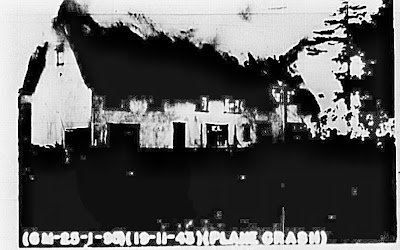 A B-17 crashed at Green Farm, near the end of the main runway, setting the house on fire and killing all those on the plane.
 The house was rebuilt. This is the new Green Farm. The bomb-laden B-17 crashed into the trees behind the house.
  Wreckage in the woods behind Green Farm.
 The same spot today.


 Aerial view of the town of Horham today.
 Aerial view showing the town of Horham and the airfield. Main runway at center.
 Alan Johnson came by this spot many days to visit his American friends on the base. The guard box was near the spot where the phone booth is located in this photo. A hundred yards or so down the lane in center, and a child was on the base.

 Alan Johnson today, in his vintage Jeep. Alan was the driving force behind preserving the history and buildings of the 95th Bomb Group in Horham.

 The Red Feather's interior before restoration began.
 The Red Feather Club today. (Photo from Tom Philo's website:


 My host Alan Johnson, who put me up in his house for six nights. We had fish and chips, went to a party, and hoisted a few beers when not working. Here Alan stands in front of the Red Feather Club, a passion of his for many year. Alan grew up near the base and has dedicated his life to remembering the American servicemen who came to the small town many years ago.


 River Liffey, Downtown Dublin.
 Looking out towards Dingle Harbor, County Kerry.


 Omaha Beach today. France.
 The Re-discovered classic infantry memoir, Etched in Purple (Potomac, 2008)