Showing posts with label memoir. Show all posts

Sunday, August 15, 2010

Book Review: 'Last Roll Call: The Adventures of a B-17 Tailgunner, 15th Air Force, 97th Bomb Group, Amendola Italy"


I had the good fortune recently to read a book by B-17 tailgunner Kenneth S. Tucker, who flew with the 97th Bomb Group in the 15th Air Force in World War Two. I also had the pleasure of communicating with his daughter, Wanda Tucker Goodwin, who helped her dad write the book. Though I've read literally hundreds of books about the air was in Europe, I was surprised at how much interesting information was in Mr. Tucker's book that I did not know about.


Most memoirs of the European air war are about the Eighth Air Force, which during and after the war garnered the lion's share of the publicity. A large part of this was simple proximity to those who reported the war. London was teeming with reporters looking for a good story, and the Eighth's bomber boys were only a few miles away. On the other hand, there were very few reporters willing or able to go to Amendola, Italy, and live in the alternately muddy and dusty tent cities there, surrounded by the crushing poverty of the Italian natives.


Mr Tucker covers his life from his early days as a son of a fisherman in Florida, though his training, and into combat in the flak-filled skies over Europe. His writing is clear, unembellished, and honest. He develops the personalities of the various members of the crew as he recounts the missions, so that one feels like one knows the young men on the crew. He also tells of his visits to various places of interest on his time off, such as Pompeii and the Isle of Capri.


Many readers of WWII memoirs are on the lookout for signed memoirs. Here is your chance to pick one up. Follow the link below to Ken's website, and put in an order for a copy of this book. He'll personalize it and autograph it. 186 pages. Soft cover trade paperback. Illustrated with black and white photographs.


Click link below or phone 850-624-8081.


Saturday, March 15, 2008

Frank Irgang's Etched in Purple Released by Potomac

The Twenty-Ninth Infantry goes ashore on D-Day. Frank was there. He tells about it in his book.


One of my most prized possessions, a signed, First Edition of Etched in Purple, published back in 1949 by Caxton Printers, Caldwell, Idaho. Frank sent me the pristine dust jacket, over fifty years old.
The new edition of Etched in Purple. If I could write one book as good as this, I could die a happy man.

The book I consider to be the greatest memoir of World War Two was released yesterday by Potomac Books. Frank Irgang wrote Etched in Purple shortly after returning from his hellish tour of duty as a medic, and, after attrition killed many of his comrades, regular infantryman in the famed 29th Infantry Division. Frank landed on the Normandy beachhead on D-Day and fougth his way through Europe, through the Battle of the Bulge, before being wounded.
What makes Frank's book so special is that he pulls no punches in relating what happened, from D-Day onwards. One of the most disturbing scenes in the book involves a German woman pouring boiling water on a wounded American soldier, as Frank watches. What would you do?
Frank has become a good friend over the years. I have no qualms admitting that my friend is also one of my heroes and mentors. His book is better than anything I could ever attempt to write. It is, in my opinion and that of Potomac Books, a 're-discovered classic'.
Don't pass this book up. It will change you forever. Frank tells it like it was, and believe me, he also proves that, in the words of General Sherman, 'War is Hell'
Who were the 29th Division? Here are some facts from the net:
Some stats and history on the 29th Division

The 29th Division was reactivated on 3 February 1941 and departed for the United Kingdom on 5 October 1942 where it continued training in Scotland and England from October of 1942 up to June 1944 in preparation for the invasion of France.
Teamed with the
U.S. 1st Infantry Division, the 116th Infantry Regiment of the 29th Division was in the first assault wave to hit the beaches at Normandy on D-Day, 6 June 1944. The division itself landed on Omaha Beach on the same day in the face of intense enemy fire but soon secured the bluff tops and went on to occupy Isigny on 9 June. The division cut across the Elle River and advanced slowly toward St. Lo, fighting bitterly in the Normandy bocage (hedge rows).
After taking St. Lo on
18 July, the division joined in the battle for Vire, capturing that strongly held city on 7 August. Turning west, the 29th took part in the assault on Brest from 25 August to 18 September.
After a short rest, the division moved to defensive positions along the Teveren-Geilenkirchen line in
Germany and maintained those positions through October. (In mid-October the 116th Infantry took part in the fighting at the Aachen Gap.) On 16 November the division began its drive to the Ruhr, blasting its way through Siersdorf, Setterich, Duerboslar, and Bettendorf, reaching the Ruhr by the end of the month.
On
8 December, heavy fighting reduced Juelich Sportplatz and the Hasenfeld Gut. From 8 December 1944 to 23 February 1945, the division held defensive positions along the Ruhr and prepared for the offensive. The attack jumped off across the Ruhr on 23 February and carried the division through Juelich, Broich, Immerath, and Titz to Mönchengladbach on 1 March. The division was out of combat in March, however in early April the 116th Infantry helped mop up in the Ruhr area and on 19 April the division pushed to the Elbe River and held defensive positions until 4 May. Meanwhile, the 175th Infantry Regiment cleared the Kloetze Forest. After VE Day, the division was on military government duty in the Bremen enclave.
The 29th Infantry Division had spent 242 days in combat during campaigns in
Normandy, Northern France, the Rhineland and Central Europe, earning four Distinguished Unit Citations in the process. Two soldiers of the division were awarded the Medal of Honor. Also awarded were 44 DSCs, one DSM, 854 Silver Stars, 17 Legion of Merit, 24 Soldier's Medal and 6,308 Bronze Stars.

The 29th in Popular Culture
In the 1962 film
The Longest Day much of the action of the 29th on Omaha Beach on D-Day is depicted, with assistant division commander Brigadier General Norman Cota portrayed by Robert Mitchum.
Close Combat, part of a Microsoft Series of wargames during the 1990s also portrayed the actions of the 29th Division from Omaha Beach to the capture of St. Lo.

In the 1998 film "
Saving Private Ryan", many of the soldiers seen in the Omaha Beach sequence are from the 29th, identified by their shoulder insignias. Corporal Timothy E.Upham, for instance, is portrayed as a soldier serving with the 29th Infantry Division. Upham was drafted to serve with a squad from the 2nd Rangers. The 29th, along with the 1st Infantry Division, were grouped with a few companies of the 2nd Ranger Battalion to storm Omaha Beach on June 6th, 1944.

Monday, October 8, 2007

Book Review: MY WAR by John C. Walter


Every so often I read a World War Two bomber crewman memoir that reaches out and grabs me. Such is John C. Walter's outstanding book MY WAR: The True Experiences of a U.S. Army Air Force Pilot in World War Two, published by Authorhouse in 2004. Not since I read the late Gene Carson's Wing Ding have I felt like I've gotten into the head and heart of a bomber crewman in such detail.


Walter flew as a pilot with the 95th Bomb Group (H) out of Horham, England in World War Two. The book begins with his enlistment and early training and follows Walter and his crew across the Atlantic to England, where they complete 35 harrowing missions in the early months of 1945 flying a Boeing B-17 Flying Fortress. Not all of the crew survives their tour, and many fellow crews also go down. Walter tells his story alternating the stress and terror of flying missions with the high-spirited living of the crewmen between missions. He explains many things that I never fully understood despite having read literally over a hundred bomber crew memoirs. I guess one could say Mr. Walter has an eye for detail that enables him to describe the experience in new and introspective ways. Considering he spent much of his career honing his writing skills as a technical writer for General Dynamics, he's had a lot of practice. He also has a wonderful dry sense of humor, which I appreciated greatly while reading.


Other plusses to the book are the good photographs throughout and the appendix, which describes in detail how to read a Pilot Information Sheet used on a mission. The book has 247 pages. It can be ordered from Amazon at this link: http://www.amazon.com/MY-WAR-EXPERIENCES-FORCE-PILOT/dp/1418447250/ref=sr_1_1/104-1823667-6149529?ie=UTF8&s=books&qid=1191892112&sr=8-1.


I managed to get hold of Mr. Walter today and I hope to use his insight and expertise while writing the 95th BG history this coming year. It is a wonderful book and I highly recommend it.

Sunday, August 26, 2007

Leonard Herman's Uniform--It's a Beauty

A collector friend of mine recently contacted me and let me know he has Leonard Herman's 9th Air Force uniform in his collection. This gentleman was kind enough to send me some photos of Len's uniform. Leonard Herman flew two tours of duty in the skies over Europe in World War Two, first with the 8th in 1943 and then with the 9th in 1944-45. He is one of my dearest friends, more like a big brother, and I love him greatly. Len is going to be 91 years old on September 8.


Leonard Herman is one of the greats of the air war, in my opinion. He was in the original 95th Bomb Group when it formed, and flew the very first mission the 95th flew, early in 1943 when only one in three men completed their tours. In the 95th, it was less than one in three at that point. Leonard flew some of the roughest missions of the war, including the disastrous Kiel mission, which nearly wiped out the 95th Bomb Group, and Schweinfurt, among others. He was wounded and his pilot killed on a mission. While in Europe, he had encounters with Curtis LeMay, Clark Gable, and Glenn Miller.

Leonard's plane, Ten Nights in a Bar Room/The Brass Rail, limps home from Trondheim, Norway, on fire and alone.


After completing his first tour, he was one of the first American flyboys to return to the States, and was part of a Bond Tour, traveling from city to city to drum up support for US Victory Bonds. He then returned to combat, flying as a bombardier on A-26s and B-26s. He flew dangerous low-level ground support missions right up to the last day of the war.


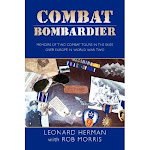
Len's story was so interesting that I decided to help him write his memoirs, in his own words. The result is Combat Bombardier, and the book was published this year. Click here to order a copy from Xlibris, https://www2.xlibris.com/bookstore/bookdisplay.asp?bookid=38755


or here to order a copy from Amazon.com: http://www.amazon.com/COMBAT-BOMBARDIER-LEONARD-HERMAN/dp/1425761313


Thanks to the collector for sending me these priceless photos of Leonard Herman's uniform.