Showing posts with label Literature. Show all posts

Saturday, March 15, 2008

Frank Irgang's Etched in Purple Released by Potomac

The Twenty-Ninth Infantry goes ashore on D-Day. Frank was there. He tells about it in his book.


One of my most prized possessions, a signed, First Edition of Etched in Purple, published back in 1949 by Caxton Printers, Caldwell, Idaho. Frank sent me the pristine dust jacket, over fifty years old.
The new edition of Etched in Purple. If I could write one book as good as this, I could die a happy man.

The book I consider to be the greatest memoir of World War Two was released yesterday by Potomac Books. Frank Irgang wrote Etched in Purple shortly after returning from his hellish tour of duty as a medic, and, after attrition killed many of his comrades, regular infantryman in the famed 29th Infantry Division. Frank landed on the Normandy beachhead on D-Day and fougth his way through Europe, through the Battle of the Bulge, before being wounded.
What makes Frank's book so special is that he pulls no punches in relating what happened, from D-Day onwards. One of the most disturbing scenes in the book involves a German woman pouring boiling water on a wounded American soldier, as Frank watches. What would you do?
Frank has become a good friend over the years. I have no qualms admitting that my friend is also one of my heroes and mentors. His book is better than anything I could ever attempt to write. It is, in my opinion and that of Potomac Books, a 're-discovered classic'.
Don't pass this book up. It will change you forever. Frank tells it like it was, and believe me, he also proves that, in the words of General Sherman, 'War is Hell'
Who were the 29th Division? Here are some facts from the net:
Some stats and history on the 29th Division

The 29th Division was reactivated on 3 February 1941 and departed for the United Kingdom on 5 October 1942 where it continued training in Scotland and England from October of 1942 up to June 1944 in preparation for the invasion of France.
Teamed with the
U.S. 1st Infantry Division, the 116th Infantry Regiment of the 29th Division was in the first assault wave to hit the beaches at Normandy on D-Day, 6 June 1944. The division itself landed on Omaha Beach on the same day in the face of intense enemy fire but soon secured the bluff tops and went on to occupy Isigny on 9 June. The division cut across the Elle River and advanced slowly toward St. Lo, fighting bitterly in the Normandy bocage (hedge rows).
After taking St. Lo on
18 July, the division joined in the battle for Vire, capturing that strongly held city on 7 August. Turning west, the 29th took part in the assault on Brest from 25 August to 18 September.
After a short rest, the division moved to defensive positions along the Teveren-Geilenkirchen line in
Germany and maintained those positions through October. (In mid-October the 116th Infantry took part in the fighting at the Aachen Gap.) On 16 November the division began its drive to the Ruhr, blasting its way through Siersdorf, Setterich, Duerboslar, and Bettendorf, reaching the Ruhr by the end of the month.
On
8 December, heavy fighting reduced Juelich Sportplatz and the Hasenfeld Gut. From 8 December 1944 to 23 February 1945, the division held defensive positions along the Ruhr and prepared for the offensive. The attack jumped off across the Ruhr on 23 February and carried the division through Juelich, Broich, Immerath, and Titz to Mönchengladbach on 1 March. The division was out of combat in March, however in early April the 116th Infantry helped mop up in the Ruhr area and on 19 April the division pushed to the Elbe River and held defensive positions until 4 May. Meanwhile, the 175th Infantry Regiment cleared the Kloetze Forest. After VE Day, the division was on military government duty in the Bremen enclave.
The 29th Infantry Division had spent 242 days in combat during campaigns in
Normandy, Northern France, the Rhineland and Central Europe, earning four Distinguished Unit Citations in the process. Two soldiers of the division were awarded the Medal of Honor. Also awarded were 44 DSCs, one DSM, 854 Silver Stars, 17 Legion of Merit, 24 Soldier's Medal and 6,308 Bronze Stars.

The 29th in Popular Culture
In the 1962 film
The Longest Day much of the action of the 29th on Omaha Beach on D-Day is depicted, with assistant division commander Brigadier General Norman Cota portrayed by Robert Mitchum.
Close Combat, part of a Microsoft Series of wargames during the 1990s also portrayed the actions of the 29th Division from Omaha Beach to the capture of St. Lo.

In the 1998 film "
Saving Private Ryan", many of the soldiers seen in the Omaha Beach sequence are from the 29th, identified by their shoulder insignias. Corporal Timothy E.Upham, for instance, is portrayed as a soldier serving with the 29th Infantry Division. Upham was drafted to serve with a squad from the 2nd Rangers. The 29th, along with the 1st Infantry Division, were grouped with a few companies of the 2nd Ranger Battalion to storm Omaha Beach on June 6th, 1944.

Friday, November 16, 2007

More on 'Etched in Purple' by Frank Irgang


I found the following book description online, and think it sheds light into the motivations and meaning of Potomac Books' upcoming re-release of Frank Irgang's classic 'Etched in Purple'. Enjoy.


The wartime experiences of Frank J. Irgang


Frank Irgang's personal record of his experiences as a combat infantryman of World War II has its beginning on the dawn of that famous day when the invasion troops landed in France.


We know the outer facts of that invasion - what was planned, how it was executed, and what happened - but what we do not know are the innermost thoughts of those crawling bits of humanity who fought their way across France and into Germany. What were they thinking? How did they meet the terror of each new day?


In this well-timed revelation of one infantryman's experiences are to be found the inner facts we have wanted to discover. And they are revealed truthfully and with a freshness of reality which it would be impossible to recapture unless the observations had been jotted down, as they were by Frank Irgang, soon after the events took place.


Frank's keen eye for seeing, his unliterary terseness, his sometimes blunt way of stating brutal truths, all contribute toward making this book more than one man's record of the war. In its unpretentiousness it says effectively and vividly what hundreds of other soldiers would have said had they found a means of expression.


ETCHED IN PURPLE The Caxton Press, Ltd., Caldwell, Idaho, 1949

Young Frank Irgang, newly returned from the bloody fighting in Europe with the 29th Division.
A more recent picture of Dr. Frank Irgang, Professor, San Diego State University


Coming soon from Potomac Books.


Wednesday, November 14, 2007

WWII D-Day Infantryman Memoir 'Etched in Purple' to be Re-Issued by Potomac Books in April 2008


It is with great excitement that I report that the best infantryman's memoir to come out of World War Two, 'Etched in Purple', by Frank Irgang, will be re-issued by Potomac Books in April of 2008.


If a reader ever wanted to live the life of an American infantryman in Europe, from the D-Day landing to the hedgerows of France to the wintry forests of Germany, this is the book to get. First published by Caxton Press in 1949, the book was the catharsis of a young vet who had seen some of the worst fighting in Europe and then had the guts and the sensitivity to write about it graphically and honestly. This book will change whoever reads it. It changed me.


I invite all my readers to be on the lookout for more information on 'Etched in Purple'. I think it may well be the next 'Band of Brothers', only better.

Monday, October 8, 2007

Book Review: MY WAR by John C. Walter


Every so often I read a World War Two bomber crewman memoir that reaches out and grabs me. Such is John C. Walter's outstanding book MY WAR: The True Experiences of a U.S. Army Air Force Pilot in World War Two, published by Authorhouse in 2004. Not since I read the late Gene Carson's Wing Ding have I felt like I've gotten into the head and heart of a bomber crewman in such detail.


Walter flew as a pilot with the 95th Bomb Group (H) out of Horham, England in World War Two. The book begins with his enlistment and early training and follows Walter and his crew across the Atlantic to England, where they complete 35 harrowing missions in the early months of 1945 flying a Boeing B-17 Flying Fortress. Not all of the crew survives their tour, and many fellow crews also go down. Walter tells his story alternating the stress and terror of flying missions with the high-spirited living of the crewmen between missions. He explains many things that I never fully understood despite having read literally over a hundred bomber crew memoirs. I guess one could say Mr. Walter has an eye for detail that enables him to describe the experience in new and introspective ways. Considering he spent much of his career honing his writing skills as a technical writer for General Dynamics, he's had a lot of practice. He also has a wonderful dry sense of humor, which I appreciated greatly while reading.


Other plusses to the book are the good photographs throughout and the appendix, which describes in detail how to read a Pilot Information Sheet used on a mission. The book has 247 pages. It can be ordered from Amazon at this link: http://www.amazon.com/MY-WAR-EXPERIENCES-FORCE-PILOT/dp/1418447250/ref=sr_1_1/104-1823667-6149529?ie=UTF8&s=books&qid=1191892112&sr=8-1.


I managed to get hold of Mr. Walter today and I hope to use his insight and expertise while writing the 95th BG history this coming year. It is a wonderful book and I highly recommend it.

Sunday, September 16, 2007

Aviation Writer Walter Boyne does it again--Supersonic Thunder

The second book in the jet-age trilogy, Supersonic Thunder, is a great read.


I have been a big fan of writer Walter Boyne for many years. He is one of the few aviation writers to succeed as both a fiction and nonfiction writer, and I've read almost everything he's ever written over the course of the last thirty years. Boyne knows whereof he speaks---he was a jet fighter pilot in the fifties and also the director of the Smithsonian Air and Space Museum. I got acquainted with Walt a few years ago, when I sent him a copy of my book Untold Valor, and Walt was good enough to read it, blurb it, and recommend it to the company that eventually published it, Potomac Books. My admiration for Walt's writing precedes the fact that he helped me out as a fellow writer, so this is, I hope, an unbiased review of Walt's latest book, Supersonic Thunder.


If you enjoy great aviation historical fiction, I can think of no one who does it better than Walter Boyne. In his latest, Supersonic Thunder, Boyne continues following the saga of the fictional Shannon family as they witness the continuing development of the jet age in America. Also followed are developments in England, France and Russia. Special projects covered in this, the second in the trilogy, include the race to build an SST, the competition between Douglas (soon to be McDonnell Douglas) and Boeing for the passenger jet market, the beginnings of the space program (including Sputnik and Gemini), the U-2 spy plane program, the SR-71 Blackbird, the development of the first super-carrier--the Boeing 747--and much more.


If you have never read a Walter Boyne book, you have missed out on perhaps the best aviation historical fiction in the world. Boyne's series on World War One and Two, the Eagles Trilogy, is simply magnificent. He also did a book on the Wright Brothers, 'Dawn over Kitty Hawk', and a fictionalized history of the Air Force, Wild Blue. Boyne has also written literally dozens of works of nonfiction. Perhaps his most acclaimed is 'Beyond the Wild Blue', a history of the United States Air Force.


I'm a big fan of Boyne's work, and have been for several decades. If you've never picked up one of his books, I urge you to do so.

Walt has a personal website at http://www.air-boyne.com/index.htm. Check it out!
The final book in the trilogy, Hypersonic Thunder, will be out in the fall of 2008. I eagerly await its publication.

Friday, August 31, 2007

One of the Most Important Books You've Never Read


As a writer, I often feel guilty that my book sells so well when there is a book out there that is so much more important that hasn't gotten the readership it deserves. 'Surviving the Americans' makes 99% of all books written about World War Two look pretty insignificant. Author Robert Hilliard is alive and well, still teaching at Emerson College and also living part-time in Florida, and his World War Two friend E. Edward Herman lives in Florida. These two great men, as young Army Air Corps privates, changed United States policy towards Displaced Persons in American-Occupied Germany after World War Two. In the process, they saved the lives of thousands of liberated concentration camp survivors--Jewish and Gentile. If ever there were heroes of World War Two, Bob and Ed are the epitome.


I got to know them when researching my book, Untold Valor, and was honored to attend the international premiere of a movie about them entitled 'Miracle at St. Ottilien', which has since shown on PBS, in many film festivals around the world, and is on its way to becoming a classic war documentary.


What's amazing is that this ground-breaking work, on a topic of great historical importance, is available on Amazon.us for just over a dollar. There is even a copy, inscribed by the author, Bob Hilliard, for sale for around twelve dollars. One of the ironies of modern American culture, when a man who was responsible for saving thousands of Jews after the war, and who stood up to no one less powerful than Dwight D. Eisenhower--and won--is a relative unknown while useless athletes and talentless actors rake in the accolades and the glory.


Following is my review of the book from Amazon:


This is an extremely important work, one that should be read by everyone who has any interest whatsoever in World War II in general, in the Holocaust and its aftermath, or in how the liberating American forces dealt with the 'problem' of what to do with the Jewish survivors of Hitler's death camps. It will make the reader reassess the accepted historical view of Americans as the saviors of Europe after World War II. Author Robert Hilliard was a young enlisted man stationed in Germany at the end of the war. Hilliard takes up the cause of helping the freed concentration camp survivors after attending a 'liberation concert' staged by Jews and hearing the speech of a Jewish doctor who has set up a hospital to care for the freed Jews. He learns that though the Jews are free, in most cases they have nowhere to go, no food, no medical care,and no clothing. Many are still wearing their concentration camp clothes months after the war ends, and some are even wearing the clothes of the hated SS guards because they have nothing else. In addition, Jews are dying with startling regularity at the hospital due to lack of food and medical supplies. To make matters worse, they must watch the 'former' Nazis who ran the country under Hitler resume their old lives, despite the evils they have perpetrated. Hilliard finds that American policy in Germany is little better than that of the Germans. Many Jews are kept in barbed wire installations, under MP guard, and have to try to live on 700 calories a day. They watch the former Nazis ingratiate themselves with the US brass through bribery, lies, and sexual favors. Hilliard and his friend Ed Herman decide to do what they can for the hospital, and this book chronicles their efforts. By the end of the book, they take their plea all the way to the top, and are instrumental in changing US occupation policy towards the freed Jews in Germany. Because of the actions of these two enlisted men, President Truman in effect reprimanded Gen. Eisenhower for his laissez-faire attitude in dealing with former Nazis and treatment of freed concentration camp survivors. The book is well-written, and could easily have run hundreds of pages. Hilliard has crafted a lean and powerful book. I hope that it will be read by many students of history, and I recommend it to any person who is not content to accept the sanitized, for-the-masses packaging of complicated historical periods.


This is one of those books that changes you if you read it. You will never look at the history of World War Two the same again. It is, literally, a must-read.


The following is a review of the important documentary about Bob and Ed entitled 'Miracle at St. Otillien':


LOCAL JEWISH FILM FEST 2007


'Displaced' tells true story of survival


BY CATE MARQUIS, SPECIAL TO THE JEWISH LIGHT


"Displaced: Miracle At St. Ottilien" is a little-known "Greatest Generation" true story, about a couple of ordinary American G.I.s who showed extraordinary courage, persistence and intelligence to save some concentration camp survivors — after the war had ended.
This short documentary is narrated by writer Studs Terkel, and features interviews with the former American soldiers, two army privates named Robert Hilliard and Edward Herman, and a group of Buchenwald survivors in a displaced persons camp.


Everyone has an image of the Allied troops defeating the Nazis and setting the inmates of concentration camps free.


But what happened next to those survivors?


The Allied Commander was too busy, with mopping up after the war, hunting down the Nazi stragglers and putting the broken countries back in order, to really pay much attention to the barely-living concentration camp survivors who had been liberated. Those well enough could make their way home could but the sickly and weak, some far from home, or with no home left, were herded into displaced persons camps, often to be neglected or forgotten.
St. Ottilien was one such little camp, a former monastery, where a group of survivors huddled on the brink of starvation.


Army privates Robert Hilliard and Edward Herman were disturbed by this treatment and began smuggling food to the refugees.


When sickness broke out among the neglected survivors, the commanders thought of fencing them in, lest disease spread to the general population.


This was too much at last for Hilliard and Herman. They set out to do something about it, using their wits to circumvent the system, with a letter writing campaign. Eventually, their efforts got the attention of President Harry Truman.


The documentary's story is told through interviews with documents and archival stills.
The story is told step by step as it unfolded, leading up to the clever twist that did the trick. Survivors are interviewed along with the soldiers themselves.


The combination of cleverness, resourcefulness and determination to do the right thing, to save these strangers, makes this short documentary a heart-warming, inspiring winner.
I am continually amazed at the remarkable moral character and sense of right and wrong coupled with the brainiest and creative wit in being able to circumvent obstacles that marked this generation that grew up in the hardships of the Great Depression.


Maybe it was FDR's message of "we are all in this together" that cemented this determination to rescue the weakest and leave no one behind.


Displaced: Miracle At St. Ottilien is a wonderful little tribute, a bit belated, to some ordinary guys who did something extraordinary, just because it was the right thing to do."


Order the movie 'Displaced: Miracle at St. Ottilien here: http://www2.bc.edu/~michalcj/displaced.html
E. Edward Herman, Left, and Robert Hilliard, Right, were two American privates who changed US policy and saved the lives of thousands of liberated concentration camp survivors after World War Two. Never heard of them? Shame on you. Time to find out.
Bob and Ed are not only my friends, I am unashamed to say they are my heroes.
Thank you, both of you, for your courageous efforts on behalf of those who were powerless, voiceless, and alone in the year immediately after World War Two.

Sunday, August 26, 2007

Leonard Herman's Uniform--It's a Beauty

A collector friend of mine recently contacted me and let me know he has Leonard Herman's 9th Air Force uniform in his collection. This gentleman was kind enough to send me some photos of Len's uniform. Leonard Herman flew two tours of duty in the skies over Europe in World War Two, first with the 8th in 1943 and then with the 9th in 1944-45. He is one of my dearest friends, more like a big brother, and I love him greatly. Len is going to be 91 years old on September 8.


Leonard Herman is one of the greats of the air war, in my opinion. He was in the original 95th Bomb Group when it formed, and flew the very first mission the 95th flew, early in 1943 when only one in three men completed their tours. In the 95th, it was less than one in three at that point. Leonard flew some of the roughest missions of the war, including the disastrous Kiel mission, which nearly wiped out the 95th Bomb Group, and Schweinfurt, among others. He was wounded and his pilot killed on a mission. While in Europe, he had encounters with Curtis LeMay, Clark Gable, and Glenn Miller.

Leonard's plane, Ten Nights in a Bar Room/The Brass Rail, limps home from Trondheim, Norway, on fire and alone.


After completing his first tour, he was one of the first American flyboys to return to the States, and was part of a Bond Tour, traveling from city to city to drum up support for US Victory Bonds. He then returned to combat, flying as a bombardier on A-26s and B-26s. He flew dangerous low-level ground support missions right up to the last day of the war.


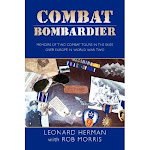
Len's story was so interesting that I decided to help him write his memoirs, in his own words. The result is Combat Bombardier, and the book was published this year. Click here to order a copy from Xlibris, https://www2.xlibris.com/bookstore/bookdisplay.asp?bookid=38755


or here to order a copy from Amazon.com: http://www.amazon.com/COMBAT-BOMBARDIER-LEONARD-HERMAN/dp/1425761313


Thanks to the collector for sending me these priceless photos of Leonard Herman's uniform.

Book Review: Tom's War by James Hammond


Veteran South Carolinian journalist James T. Hammond has written a great new book entitled 'Tom's War: Flying With the Eighth Air Force in Europe, 1944', published by iuniverse in 2007. James' father, Tom Hammond, was the son of a small-plot farmer in Greer, South Carolina. Young Tom was fascinated by airplanes and when war broke out, he went into the Army Air Corps and became a B-17 pilot in the 95th Bomb Group. This book follows Tom through 'Tom's War', from training to combat and the eventual joyful return.


Shortly before he leaves for duty, Tom meets a young neighbor named Callie and the two maintain a correspondance throughout the war. The letters begin as friendly pen-letters and turn into love letters over time. One of the things that makes the book so poignant is Hammond's reliance on these letters back and forth between Tom and Callie. In addition to chronicling Tom's war and Callie's difficult job at a shirt factory, where she buttons Army shirts all day long, the letters allow the reader to witness a young couple falling in love with each other.


When author Hammond delves into the personal lives and feelings of his characters, this book really soars. It bogs down a bit in the mission-by-mission details, especially if, like me, you have read hundreds of accounts of the air war. However, for a layman, who knows little of the planning and execution of missions over Europe, this would probably provide valuable insight.


Tom was a co-pilot who flew with the same crew for all thirty-five missions, give or take a couple of make-up missions. By this time in the war, crews were required to fly 35 rather than 25 missions, in part to speed the end of the war and in part because of the decreased risk of the depleted German Luftwaffe. By mid-1944, the main threat was the highly accurate German flak.


James Hammond tells the story of Tom's joyful return, his long recovery at a hospital in the Miami Beach area after nose surgery, and his reunion with the woman he loves.


Tom Hammond's next war will be waged against dementia, lung, and heart ailments that eventually claim him in his early eighties. Son James' story here is powerful and compelling in its universality. The titans who saved the world at age 20 are now leaving us as old age accomplishes what fighter and flak failed to do. By the time Tom Hammond passes away, one feels a bond with the scrappy farm kid who grew up in the South during the Depression, and one feels a real sense of sadness that is mitigated only by the selfless care given to him by the love of his life, his wife Callie.


Hammon ends the book by tracking down his father's crewmen. It's interesting to see how time has treated each man. Some have become successful, others have never really got the gears turning.


This is a fine tribute to a member of the Greatest Generation. I recommend it to anybody who has an interest in World War Two bomber stories.


Friday, August 17, 2007

Another Great WWII Bomber Blog and New Book by South Carolina Writer


A few weeks ago I came in contact with a gentleman by the name of James Hammond, a journalist in South Carolina who recently published a book about his pilot father's time in the 95th Bomb Group in England in 1944. The book is called Tom's War, and I just received my copy yesterday and will dig into it with gusto this evening.


Jim also has a good blog at this address: http://jamesthammond.blogspot.com/

He covers stories about World War Two airmen, same as me, and his stories are interesting and unique. I highly recommend readers check out Jim's new blog and his book, which I will review after finishing it.


Thursday, August 2, 2007

Author of 'Rhapsody in Junk' on radio this morning

I just received word that my friend and colleague Marilyn Walton, author of 'Rhapsody in Junk', (see my previous story on the book at this link: http://untoldvalor.blogspot.com/2007/07/daughters-love-fathers-service.html ) is giving an interview on a Cincinnatti radio station in roughly an hour. I know that's short notice for most readers, but hopefully a few will be able to listen. Marilyn's dad flew on a B-24 and was shot down, becoming a POW. Her extensively researched and intensely personal book is the result of years of work, a real labor of love on her part and a fine tribute to her late father.

Marilyn writes:
I am being interviewed on Cincinnati radio this afternoon. If you are bored and not doing anything, you can listen to the interview on.
http://www.wmkvfm.org/ at 1-1:30.
Since this is easy to do, all the Germans I met are listening! Boy, my dad would have gotten a kick out of that!


The link doesn't appear to be hyperlinked. However, when I cut and pasted it into the address box, it popped up fine for me.

That's one o'clock Eastern Time, noon central, eleven Mountain, and ten Pacific.

Give Marilyn a listen. It's sure to be interesting!

Sunday, July 29, 2007

Novel Update

It's been my goal for a long time to write a novel about the Air Corps over Europe in World War Two. I wanted to tell the story, from enlistment through training and combat, followed by, in the case of my story, imprisonment in a German POW camp and a forced march at the end of the war. Historical fiction, however, is not worth telling unless it is accurate and rings true.

This summer, I've been working steadily on the novel. I have been very lucky to have eleven men who were 'over there' as my advisors. These eleven do everything from answer daily questions about anything from the cost of cigarettes to the best pub in London. They describe the terrors of combat and the humor of service life. Several also are reading the manuscript as I go in order to catch factual errors or correct scenes which do not ring true.

Their comments and emails alone run to a document of almost fifty pages so far, and this will be an important historical document in and of itself.

The novel should run about 80-100,000 words when complete. Though it deals with the entire Air Corps experience, I've also tried to make it character-driven. There are several unusual plot twists and it all builds to a surprise ending (what novel doesn't).

I'd like to thank my technical crew of advisors for their help all summer. They are:

1. Don Lewis, 15th Air Force, gunner, POW, Long March
2. Norris King, B-17 gunner, Shot down by Swiss, Internee
3. Will Lundy, 44th BG Ground Crewmen and historian, Flying Eightballs
4. Maurice Rockett, 95th BG, B-17 bombardier, Purple Heart
5. Delbert Lambson, 390th BG, Ball Turret Gunner, POW, Long March
6. Bob Cozens, 95th Bomb Group, Lead Pilot, Original member of 95th
7. John Carson, 15th Air Force gunner/armorer, POW
8. Dan Culler, 44th Bomb Group, B-24 engineer, Swiss internee and survivor of Wauwilermoos, a Swiss federal prison
9. Gale House, 95th Bomb Group, Chief Pilot, original 95th
10. DeWayne ‘Ben’ Bennett, B-17 pilot, 384th BG.
11. Leonard Herman, 95th BG, B-17 Bombardier, Purple Heart

Once the initial draft is completed, there will be re-writing and revision, but I've always found the initial drafting to be the hardest. My guess is, with a team of editors like the ones above, the revision could be a lot of fun.

Monday, July 23, 2007

High Flight--A Great Air War Poem

High Flight


Oh! I have slipped the surly bonds of Earth
And danced the skies on laughter-silvered wings;
Sunward I've climbed, and joined the tumbling mirth
Of sun-split clouds, — and done a hundred things
You have not dreamed of — wheeled and soared and swung
High in the sunlit silence. Hov'ring there,
I've chased the shouting wind along, and flung
My eager craft through footless halls of air. . . .


Up, up the long, delirious burning blue
I've topped the wind-swept heights with easy grace
Where never lark, or ever eagle flew
—And, while with silent, lifting mind I've trod
The high untrespassed sanctity of space,
Put out my hand, and touched the face of God.


John Gillespie Magee, Jr


John Gillespie Magee, Jr., was born in Shanghai, China, in 1922 to an English mother and a Scotch-Irish-American father, He was 18 years old when he entered flight training. Within the year, he was sent to England and posted to the newly formed No 412 Fighter Squadron, RCAF, which was activated at Digby, England, on 30 June 1941. He was qualified on and flew the Supermarine Spitfire.

Flying fighter sweeps over France and air defense over England against the German Luftwaffe, he rose to the rank of Pilot Officer.

On 3 September 1941, Magee flew a high altitude (30,000 feet) test flight in a newer model of the Spitfire V. As he orbited and climbed upward, he was struck with the inspiration of a poem — "To touch the face of God."


Once back on the ground, he wrote a letter to his parents. In it he commented, "I am enclosing a verse I wrote the other day. It started at 30,000 feet, and was finished soon after I landed." On the back of the letter, he jotted down his poem, 'High Flight'.


Just three months later, on 11 December 1941 (and only three days after the US entered the war), Pilot Officer John Gillespie Magee, Jr., was killed. The Spitfire V he was flying, VZ-H, collided with an Oxford Trainer from Cranwell Airfield flown by one Ernest Aubrey. The mid-air happened over the village of Roxholm which lies between RAF Cranwell and RAF Digby, in the county of Lincolnshire at about 400 feet AGL at 11:30. John was descending in the clouds. At the enquiry a farmer testified that he saw the Spitfire pilot struggle to push back the canopy. The pilot, he said, finally stood up to jump from the plane. John, however, was too close to the ground for his parachute to open. He died instantly. He was 19 years old.

Read more about Magee and his poem at http://www.skygod.com/quotes/highflight.html

The poem was made famous by President Ronald Reagan. Speaking at the memorial service for the Challenger Space Shuttle astronauts, Reagan said:

"We shall never forget them nor the last time we saw them, as they prepared for their mission and waved good-bye and slipped the surly bonds of Earth to touch the face of God."

Sunday, July 22, 2007

Book Review: Dewayne 'Ben' Bennett Offers Signed Copies

My friend Dewayne 'Ben' Bennett, former B-17 pilot and active historian who still leads visitors on tours down at the Pima, Arizona Air Museum, has a book for sale that I highly recommend. Ben has a great sense of humor and tells the story of how an Iowa farm boy ended up piloting a four-engine bomber over Europe. You can purchase the book on the 384th Bomb Group website or I also noticed today that Ben is offering one on eBay for a bargain.


Stories of a B-17 Bomber Pilot by Dewayne "Ben" Bennett


In Ben's own words:
"I flew combat in the 384th bombardment group in the 545th squadron out of Grafton Underwood, England. Some of these stories have added humor and some reflect the true combat situations. My name is Dewayne “Ben” Bennett and I’m the author of this little endeavor for which I’m very proud. I became known and answer to the name of “The Squawkin’ Chicken Skipper” because the name of our B-17 airplane was the “Squawkin Chicken.” Along with my crew we flew 31 combat missions over the war-torn countries of Germany, France, Belgium, Holland, and Poland. Thankfully we all survived. This little book is 6 by 9 inches, contains 93 pages and is a paperback. We will personalize it to you or a friend before we send it out. If you have any questions please send me an e-mail and I’ll answer it immediately. "


For price and availability, contact: Dewayne "Ben" Bennett (Clicking on Ben's hyperlinked name will put you in touch with him)


Ben currently has a book up for auction on eBay. He'll sign and personalize it to boot. The eBay auction is at http://cgi.ebay.com/STORIES-OF-A-B-17-PILOT_W0QQitemZ200130424838QQihZ010QQcategoryZ4717QQcmdZViewItem


Here is your chance to pick up a little piece of aviation history by a great man and a living legend.


The painting below is of Ben's plane. I featured it in a recent post.

Monday, July 2, 2007

A Daughter's Love, A Father's Service

As you know from my post yesterday, I just finished a wonderful book by my friend Marilyn Walton entitled Rhapsody in Junk: A Daughter's Return To Germany To Finish Her Father's Story (Paperback - AuthorHouse, May 2, 2007). This story would be of great interest to any Air Corps enthusiast, especially the sons and daughters and grandchildren of the men who flew the heavies over Europe in World War Two. I asked Marilyn if I could share some photos from her story on this blog, and she graciously accepted, so here are some photos of Marilyn's search for her father's story, direct from her new book.


Photo above is of Lt. Thomas Jeffers, B-24 bombardier, Rhapsody in Junk. Mr. Jeffers passed away in June of 2004 at the age of 83 after a series of debilitating strokes.


The B-24 Liberator 'Rhapsody in Junk'. Thomas Jeffers served as the bombardier on this aircraft when it was shot down over Germany in 1944. Nine of the ten-man crew survived by parachuting from the stricken plane. The tenth was found dead on the ground, after either striking the tail section on bail-out or from being killed by German civilians.


Above, the field where Jeffers landed after bailing out.

The farmhouse, built in the seventeenth century, that was almost hit by Rhapsody in Junk before it crashed into a nearby wood.

A few years ago, Marilyn and her husband John returned to the town and interviewed witnesses of the crash. Here, one witness motions to a point in the woods where the plane impacted. There are still four craters created from the plane's massive engines, and one tree still bears the scars of impact. Though most of the plane was removed by the German government within a day or two of the crash, locals kept some pieces and used them to make everyday household objects, including coat hooks and a tea strainer. Marilyn was given these pieces on her visit.

A write-up in a German newspaper about the visit, which generated great interest in that area of Germany. The Waltons found the Germans to be helpful, and learned how the German civilians had endured during the war. Much of the translating was done by the young man in the above picture, Matthias Martensen, seen wearing the jean jacket.

A tea strainer and a coat hook, made by local German civilians from the wreckage of Rhapsody in Junk. Also shown is a piece of the aircraft's rubber tire, found in the woods.


Some of the articles found at the crash site later, using a metal detector and other techniques

My thanks to Marilyn Walton for sharing these photos. The photos are to be found in the book, but are shown here in color.

Sunday, July 1, 2007

Book Review: Rhapsody in Junk

I just finished this book last night. It's a great read and highly recommended. Marilyn Walton has produced an important addition to the Air Corps history that deserves to be read by anyone interested in this period. What follows is my book review of Marilyn Walton's Rhapsody in Junk: A Daughter's Return to Germany to Finish Her Father's Story.

"This book is both great history and a wonderful personal narrative.

Thomas Jeffers is an aging bombardier suffering the debilitating effects of a series of strokes. His daughter, Marilyn Walton, becomes determined to find out all she can about her father's World War II experiences as a B-24 Liberator bombardier and prisoner of war. Her quest, through the miracle of the internet, phone calls, and snail mail, takes her to his long-lost crewmen, to an understanding of his wartime experiences, even to the spot where her father's plane crashed in a German wood sixty years ago. During her journey, she learns much about her father, the nature of courage and suffering, an incredible array of Air Corps history, and about herself.

Jeffers and his crew mates on the B-24 Rhapsody in Junk were shot down over Germany and forced to parachute at low altitude. Their plane crashed into a wood near a small German village. Jeffers endured interrogation and imprisonment in one of the German Luftwaffe's Stalag Lufts, the same camp where the Great Escape took place. Near the war's end, as the Russian Army threatened to recapture the camp, the men of Stalag Luft I were force-marched great distances in one of the coldest winters of the twentieth century.


Like most of the men of the Greatest Generation, Jeffers returned from the war and put it behind him, raising a family and living an exemplary life. As strokes began to rob him of his memories, Walton became determined to re-discover them before it was too late. She educated herself in the maze of official paperwork recounting her dad's training, missions, and the demise of Rhapsody in Junk. She studied the MACR for clues about where the plane came down, and where the men were captured and moved. She tracked down surviving members of her father's crew. And with the help of a young German high school student, she made two trips to the German village where the plane crashed, even finding pieces of the plane that had been salvaged by villagers and turned into everyday objects. Her journey also brought home the point that the war had brought great suffering to civilians on both sides, and she shares stories of the German people she met and befriended on her visits.


In the end, Walton successfully pieces together, from beginning to end, the story of her father's war experiences, using primary documents, interviews, and good old-fashioned heavy reading. It is a book which will appeal to anyone who has had a father in the Air Corps in World War Two, especially one who was a Prisoner of War. What makes the book truly special is that Walton is a born storyteller, and she mixes personal observations about her relationship with her father both in the past and in his final days with her war story. It thus becomes a book not only about one man, one air crew, and the war they fought, but an intensly personal book about a daughter's love for her father and her need to preserve his story for future generations.


Friday, June 29, 2007

Herb Alf and Petals of Fire

Geri Morris, Herb Alf, and Rob Morris in Roseburg, Oregon, c. 2003. Geri and Herb are holding some of Herb's original notes he took as a POW in a German prison camp. These notes formed the nucleus of his World War Two novel Petals of Fire. He wrote on both sides of sheets of toilet paper, and hid the work in a secret compartment in his wallet. Herb was one of the only survivors on his B-17 Flying Fortress after it took a direct hit and exploded. He then survived prison camp hardships and a forced march across Germany in 1945.


Today's recommended book is 100th Bomb Group pilot and POW Herbert Alf's Petals of Fire. Herb conceived and wrote this book over a fifty-year span. He began it as a prisoner of war in Germany, writing on BOTH sides of sheets of toilet paper, which he stored in a 'secret compartment' in a dime store wallet. The Germans never found it. In 1999, Petals of Fire was published in a limited quantity of 2,000 books. It is almost impossible to find a copy anymore, but anyone wishing to read it, get in touch with me about possibly borrowing mine. It is a historical novel in which Herb tried to cover all aspects of strategic aerial bombing.


I had the good fortune to get to know Herb quite well while writing my own book. We had several very enjoyable days together at his home in Roseberg, Oregon with Herb and his wife Sylvia.


Herb passed away a few years ago and is buried in Arlington National Cemetery. He was an artist, a sculptor, an educator and one of the finest men I've ever met. His book is must reading for any air war historian or 100th Bomb Group member, especially anyone interested in the POW experience.

One of the only known photos of Herb as a pilot, taken when he was in flight training Stateside. Enlarged and edited for clarity and color by R. Morris

Monday, June 11, 2007

Highly Recommended Reading on World War Two

Etched in Purple--The Greatest WWII Infantryman Story, by Frank Irgang


Technically, the story of an Army infantryman doesn't fit in a blog on World War Two airmen, but since it's my blog, I can break the rules.

Frank Irgang's Etched in Purple is my favorite book about the U.S. infantry in Europe in World War Two. Frank, who still teaches the occasional college class at San Diego State, landed on D-Day as a medic with the 28th Infantry. This unit took such heavy casualties that he ended up becoming a scout. He fought in the major battles of the European campaign, and saw some terrible things. After the war, he returned, and as part of his catharsis wrote his outstanding recounting of his experiences, Etched in Purple. The book was published by Caxton Printers in Caldwell, Idaho in 1948, and sold several thousand copies.

About ten years ago, I was in a thrift store when I came upon a copy of Etched in Purple, signed by Frank to its former owner in 1952. I bought it, read it, and the book touched me as few books have before or since. It is raw, honest, and disturbing. I tracked Frank down in California, wrote him, and we began a correspondence that has lasted to this day. Recently, I recommended Etched in Purple to my publisher, and it is currently being considered for re-issue. If this book is re-issued, it will be the proudest moment of my literary life. For I believe Etched in Purple is destined to become a classic.

Unfortunately, the book is out of print, and finding one is near-impossible. Let's hope for the best!